
Share this
by Justis Gipson on Apr 24, 2026, 9:53:45 AM

Live tutoring platforms need to be reliable. When a student logs in at 9:00 AM for their session, it needs to work.
Not most of the time - every time.
I'm the Site Reliability Engineer at BookNook, so that's my job. Here's what actually has to happen for sessions to run smoothly, and why it matters for the students and districts relying on the platform.
What Happens When a Session Starts
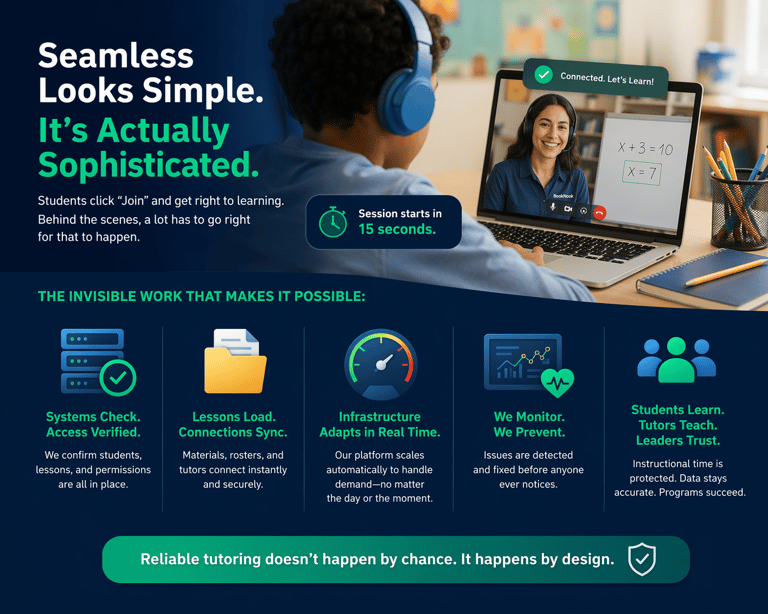
From a student's perspective, joining a session is simple. They log in, see some games while they wait, then get a notification when their tutor is ready. They click join, and fifteen seconds later, they're in the session with materials loaded.
Behind those fifteen seconds, there's a series of checks initiated to check connections, verify student access, and to load session materials. For tutors starting a session, it's similar—about thirty seconds of system checks, coordinating multiple services that all need to work together instantly.
Any one of those steps can fail. Our cloud provider could have an issue. Data might not sync correctly. There could be a bug in the code. Third-party authentication providers like Clever or ClassLink could be slow or down. The job is making sure that when something does go wrong, students and tutors don't notice.
When Everything Goes Right, Nobody Notices
A few weeks ago, on the first Sunday night of my PTO, our monitoring flagged a memory issue. Server memory was climbing steadily and never releasing. Database CPU was pegged at 100% capacity. The bug was in our code-servers couldn't scale down even after sessions ended.
If that hadn't been caught and fixed over the weekend, good chance Monday morning's sessions wouldn't have started as expected. Instead, hundreds of students logged in that Monday. Every session connected. Not a single support ticket about sessions failing to start.
This is what reliability looks like.
The Neverending Infrastructure Evolution
In February 2025, we kicked off a cloud provider migration. For users—students, tutors, administrators—nothing changed. Sessions started at the same time. The platform looked identical.
But the foundation changed completely. Previously, the system scaled on a fixed schedule - servers spun up every morning before peak session times and were shut down in the evening. It worked, but it was rigid, expensive, and struggled to keep up with the ever-growing load the platform saw. Everything we did was reactionary.
The initial migration improved things, but we were still working around old limitations. This year, we finished modernizing how the platform scales. Now it responds in real time to actual student demand. When 200 sessions start simultaneously, capacity increases automatically. When sessions end, it scales back down.
The results: faster response times during peak loads, faster deployments, reduced over-provisioning during off-peak hours, lower costs, and significantly better visibility into platform health. With our older system, monitoring was limited. Now, we can see exactly what's happening across the stack in real time—which is how that memory bug got caught before it became a problem.
Why This Matters
Technical reliability isn't just an IT concern. It directly impacts students and program success.
Instructional time is protected. When sessions start on time every time, students aren't losing minutes to technical delays. Over a semester, those minutes add up.
Data accuracy matters. Session attendance, progress tracking, and outcome reporting depend on systems capturing and syncing data correctly in real time. If that pipeline breaks, districts lose visibility into program effectiveness right when they need it most.
Trust is fragile. If a student's first experience with tutoring is "it doesn't work," you've lost them. If a tutor has to spend session time troubleshooting tech instead of focusing on instruction, the program is more of a burden than a resource.
Reliable infrastructure makes tutoring feel seamless. That's the point. Students focus on learning. Tutors focus on teaching.
Administrators get accurate data. The technology disappears into the background, which is exactly where it should be.